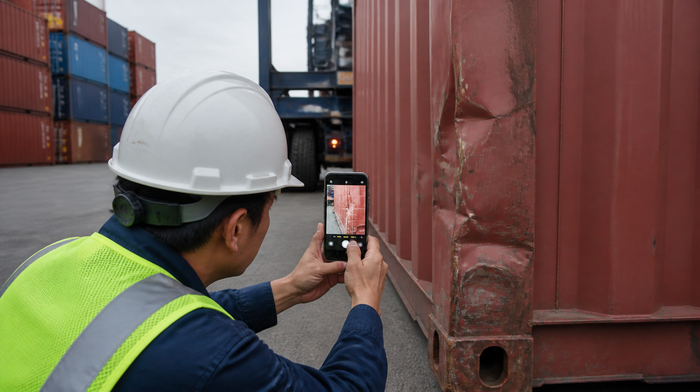
The claim is about custody, not about opinion
Interchange disputes come down to a simple question: what condition was this container in when it entered your gate, and what condition was it in when it left? Everything else is commentary. IICL-6 and similar criteria tell you which dents, holes, broken welds, door-gear failures, and corner-casting damage are repairable. They do not, by themselves, prove when the damage happened or who had the box.
If you cannot show a gate-in baseline, the damage is treated as having occurred on your watch, or on the customer’s. If you cannot show a gate-out record, you cannot answer a later off-hire invoice. Fair wear versus damage is a later conversation. First you need the before and the after, on the same container.
An EIR is not enough
The Equipment Interchange Receipt is still the official piece of paper. Tick-boxes for walls, roof, floor, and doors, a signature, a timestamp. Lines and lessors will keep asking for it. Treat it as necessary and incomplete.
An EIR that says “dent, left side” does not show the size, the location relative to a corrugation, or whether the number on the form matches the number on the steel. Months later, when a repair estimate arrives with CEDEX-style location and damage codes, that tick-box will not carry the argument. The photo will, if you took it, if it is sharp, and if the container number is in the shot.
What a photo actually has to do
A useful claim photo does four things at once. It shows the damage. It shows where on the box that damage sits. It shows the ISO 6346 number, or is stored against a record that already verified that number. And it carries a timestamp you did not type in after the fact.
A close-up of a hole with no context is easy to dismiss. A wide shot of the whole side with no close-up is easy to argue about. You want both, plus a shot of the CSC plate on the left-hand door so identity is not in doubt. If the stencil is worn, that is not an excuse to skip the number. It is the reason to let software read it and to photograph it anyway.
Do not invent a universal deadline. Some leasing platforms give the receiving party a handful of working days to open a claim or the unit is deemed returned as-is. Line contracts vary. The practical point is the same: if your evidence is not already attached to the container the day it gated in, you will be hunting for it after the window has closed.
Gate-in is the whole defense
The survey that saves you money is the one you do when the truck is still on the apron, not the one you reconstruct after a complaint. Pre-existing damage that is not photographed at intake becomes new damage the moment someone else looks at the box. That is how depots end up paying for a forklift poke that happened two depots ago.
Walk the unit the way a claim will be argued: number, CSC plate, four sides, roof if you can see it, doors and door gear, floor, understructure, corner castings. Note what meets IICL thresholds and what is fair wear. Then get the truck moving. Software that makes that sequence fast is not a luxury. It is the only way the sequence actually happens on a busy gate.
Tie every file to the right box
A transposed digit in the container number makes the entire file worthless. The photos are real. They just belong, in the system, to a unit that never had that dent. ISO 6346 builds a check digit into the eleven-character code for exactly this reason. Manual entry at a noisy gate will get it wrong. The record should read the owner code, serial, and check digit from the stencil and refuse to file the photos until that number is valid.
When the line asks for MSCU1234567, you should be able to pull that unit and only that unit: gate-in photos, gate-out photos, any repair shots in between. Not a shared drive named “July surveys.” Not a WhatsApp thread.
If you repair it, photograph it twice
Depots that also do maintenance and repair have a second claim surface. Lines authorize work off an estimate. They later query the bill. Before-repair photos prove the damage you priced. After-repair photos prove the work was done. Both belong on the same container record, dated, with the number visible. A workshop that only keeps the estimate has nothing to send when accounts payable asks why a panel was replaced.
It has to still be there when they ask
Claims do not arrive while the inspector is still standing at the box. They arrive after the unit has left, after the phone has been wiped, after the person who did the survey has moved to nights. Defense is a retrieval problem as much as a capture problem.
Store the record in a cloud database keyed by container number, not on the device. Make sure you can export it. Make sure more than one person can find it. A line equipment desk does not care that your inspector “has it somewhere.” They care whether you can send the gate-in set this afternoon.
Putting it together
A depot that can defend damage claims does not need a better argument. It needs a habit: every interchange photographed, every file tied to a verified ISO number, every CSC plate and IICL-relevant hit in the record, and all of it sitting in one place when the estimate lands. The software is there to make that habit cheaper than the clipboard, not to replace the surveyor’s eye.
Cargo Capture was built for that habit. Inspectors capture in the yard on a phone, the app reads the container markings, and the photos and notes land in a cloud database you can pull by unit when a claim shows up. If you are tired of losing arguments you probably won on the day, we would be glad to show you how it works.
Get started with Cargo Capture
Contact us at cargocapture.ai email info@ocrsolutions.com or search for Cargo Capture in the App Store and try it out.